



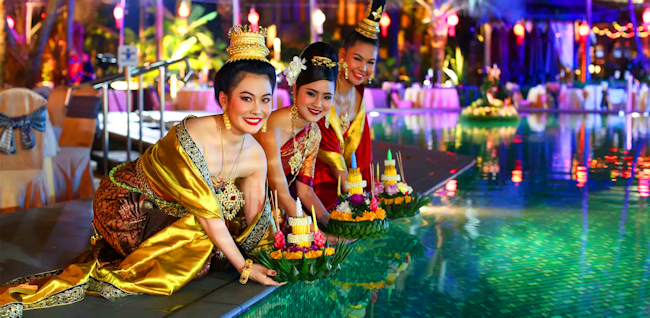
Thais will venture out to float their “krathong” in public waterways today (November 8) for the first time in three years, now that Covid-19 restrictions have been lifted.
Loy Krathong fairs and festivities have also been given the green light in Bangkok and provinces, provided partygoers keep public safety in mind.
The Nation invites readers on a journey to explore the sacred origins of Thailand’s “festival of lights” and the place it holds in the hearts of millions of modern revellers.
Loy Krathong is observed in Thailand and several other nations on the full moon night of the 12th lunar month.
Outside Thailand, the festival is known by many different names. For instance, it’s “Tazaungdaing” in Myanmar, “Ill Full Moon Poya” in Sri Lanka, “Lantern Festival” in China and “Bon Om Touk” in Cambodia.
The festival was traditionally held to pay respects to Ganga, the Hindu goddess of forgiveness and purification personified from India’s Ganges River. In Thailand, she is Phra Mae Khongkha, the goddess of water.
There is no historical evidence indicating exactly when Loy Krathong began in Thailand, but several narratives suggest that the Sukhothai Kingdom adopted the festival during the reign of King Ramkhamhaeng the Great (1279-1298).
One legend says that Loy Krathong was started by a Sukhothai court lady called Nopphamat, who reportedly created the first krathong.
The name Nopphamat has also become synonymous with the Loy Krathong festival, with communities selecting their very own “Nopphamat Beauty Queen”.
According to an account written by King Rama IV in 1863, Loy Krathong was a Hindu festival adapted by devout Thais to honor both Buddha and the goddess of water.
Traditionally, krathongs were made from a slice of a banana tree trunk or the base of a spider lily plant and decorated with banana leaves, flowers, incense sticks and a candle.
Modern krathongs, however, are often made of bread, paper or Styrofoam.
On Loy Krathong night, people head to river piers, canals or ponds to float their krathong with lit incense sticks and candles. Their belief is that this offering to Buddha and other venerable spirits will take away their worries, anger, hatred and other sins.
Some people even add their nail clippings or a small chunk of hair to symbolize letting go of past transgressions and negative thoughts. A coin is also included as an offering to the river spirits.
Loy Krathong celebrations in the North of Thailand, however, are very different, with northerners floating their krathongs in the air instead of in the water. The name of the festival is also different, referred to as “Yi Peng”, with “yi” meaning 2 and “peng” meaning full moon.
Apart from releasing their krathongs in the air and decorating their homes and streets with bright lanterns, northerners also mark Loy Krathong by visiting temples to make merit and listen to sermons.
Source: The Nation