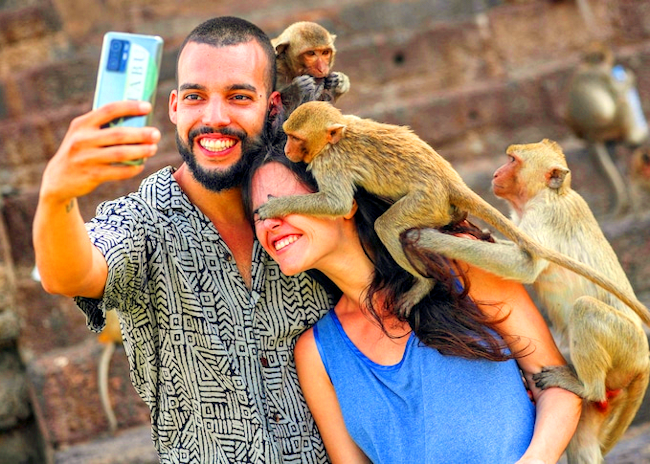



Most tourists visiting Thailand think the wild monkeys are cute.
However, most are not aware of how dangerous these wild monkeys can be.
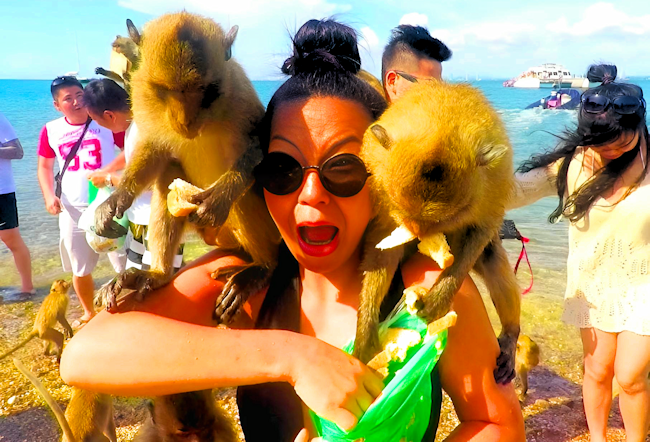
Thailand is home to many different species of primates, but the most common monkey you’ll see when visiting is a macaque (pronounced “ma kak”), a small, gray or gray-brown animal that usually hangs out in trees or other foliage.
The average Thai macaque is about two feet tall and weighs approximately 15 pounds, but just because these monkeys are small doesn’t mean they can’t harm you.
In fact, macaques in Thailand can be quite aggressive—injuries from these primates that require hospital care are reported yearly, and authorities have even put up signs warning people to beware, but incidents continue to occur.
People who turn away (often in fear) or try to stop them from taking food are sometimes scratched or bitten. If your tour guide gives you bananas for the monkeys, you can decline to participate as it’s just as fun to watch the monkeys from a distance.
The safest way to feed these creatures is to throw the food toward the monkeys instead of waiting for them to take it out of your hand, as you would with any wild animal, and make sure to be aware of your surroundings so other monkeys don’t try to sneak up behind you.
These primates are very protective of their young. Do not approach or try to touch a young monkey or approach a mother monkey while she’s nursing her baby. Because macaques are highly social creatures, if they sense a threat to one of their pack, they’ll come to the defense of one another.
Since baby macaques are more trusting, less aggressive, and appear to be friendlier than their older counterparts, tourists will often try to approach these smaller creatures first. However, if an older monkey feels like you are threatening one of the young, you might be attacked by the entire pack!
Here’s are the diseases and pathogens that Thai monkeys can carry. If you get bit or scratched, make a fast beeline to the nearest hospital:
- Simian Foamy Virus (SFV):This virus is prevalent in long-tailed macaques in Thailand and is correlated with age.
- Hepatitis B Virus (HBV):HBV sequences found in long-tailed macaques are similar to those from orangutans.
- Plasmodium spp.:Plasmodium DNA, specifically P. inui, was identified in long-tailed macaques.
- Herpes B Virus (Herpesvirus simiae):This virus is known to infect macaques and can be transmitted to humans through bites, scratches, or contact with monkey fluids.
- Other Potential Zoonotic Pathogens:Studies have also indicated the presence of other potential zoonotic pathogens in Thai monkeys, including Mycobacterium spp., and adenoviruses.
- Rabies:While rabies is not a primary reservoir in non-human primates, there are documented cases of rabies transmission from monkeys to humans, particularly in areas where rabies is endemic.
- Tuberculosis (TB):Non-human primates are susceptible to TB and can contract it from humans or other animals, especially in areas where human TB is prevalent.
WARNING: Do not encourage, feed or let these monkeys climb on you!