

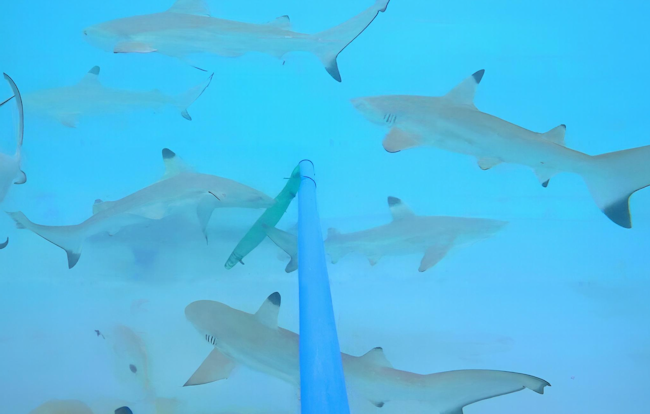

KRABI — Maya Bay’s remarkable ecosystem recovery reached a new milestone on July 3 when researchers counted 158 blacktip reef sharks swimming in the famous Krabi bay—the highest number ever recorded in a single survey.
The Marine National Park Study and Research Center 3 (Trang) conducted the groundbreaking survey from July 2-8 as part of their “Shark Watch Project,” using cutting-edge technology to monitor the blacktip reef shark population in Hat Noppharat Thara – Mu Ko Phi Phi National Park, Krabi Province.
Researchers deployed two sophisticated methods: aerial drone photography to count sharks from above, and underwater baited remote cameras (BRUVs) to observe natural behavior patterns. The morning of July 3 delivered the survey’s peak moment when all 158 blacktip reef sharks (Carcharhinus melanopterus) were simultaneously spotted in the bay.

Marine National Park Study and Research Center 3 (Trang) reveals survey footage tracking the population and behavior of blacktip reef sharks (Carcharhinus melanopterus) in Maya Bay, Hat Noppharat Thara – Mu Ko Phi Phi National Park, Krabi Province (Shark Watch Project) during July 2-8, 2025.
The large shark population signals excellent marine ecosystem health in Maya Bay. Blacktip reef sharks serve as apex predators, playing a vital role in maintaining underwater food chain balance and indicating pristine environmental conditions.
“This discovery shows that Maya Bay continues to provide suitable habitat for these marine species,” the research team noted. The sharks’ presence demonstrates that ongoing conservation efforts are successfully restoring the bay’s natural balance.
The research team plans comprehensive analysis of the collected data to better understand blacktip reef shark behavior and life patterns in Maya Bay. These findings will create an essential database for sustainable conservation planning and national park management strategies.
The results will also inform eco-tourism development, helping balance visitor access with habitat protection as Maya Bay continues its recovery journey.
Maya Bay’s transformation from over-tourism victim to thriving marine sanctuary showcases the power of dedicated conservation efforts. The record shark count provides tangible proof that ecosystem restoration initiatives are delivering measurable results, positioning the bay once again in the positive spotlight for all the right reasons.
Source: Khaosod English