


If you are one of the many foreigners in Hua Hin, or elsewhere in Thailand, who bought property through a Thai-registered company using nominees, recent enforcement changes mean this issue should not be ignored.
A recent seminar in Hua Hin has highlighted growing legal risks for foreign residents who bought property through Thai-registered companies using nominee shareholders, as Thailand intensifies a nationwide crackdown on structures used to bypass land and business ownership laws.
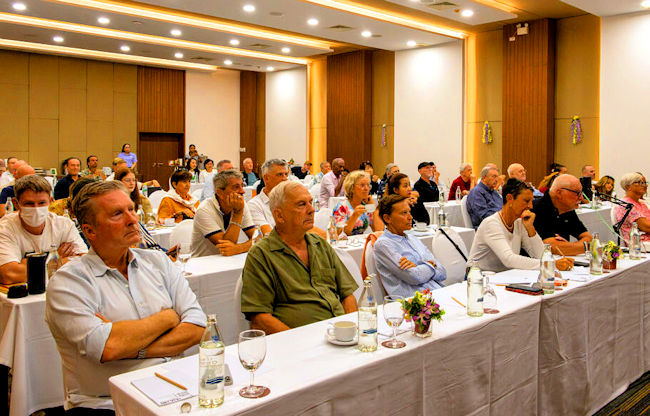
The seminar, titled “2026 Expat Crackdown: What Every Expat Must Understand” was organised by MBMG Group, Hua Hin Accounting & Law and held on 14 January at the G Hotel. It brought together long-term foreign residents, legal advisers and accountants to explain how enforcement has shifted from periodic checks to sustained, data-driven investigations.
Speaking at the event were Janjira Sumanus, Chief Executive Officer of MGMB Group; Natthapol Trichote, a lawyer at MGMB; Winai Panithaarakchai, a tax auditor; Lewis Murawski, Managing Partner at Kahouze; and Craig McCavinue of Tenzing Pacific Services.
For decades, buying a house “in a company name” was widely used by foreigners purchasing land or villas in Thailand and was often regarded as the safest available option. Speakers at the seminar warned that this assumption no longer holds. What was once treated as a grey area is now being viewed by authorities as a clear breach of Thai law where Thai shareholders exist only on paper and lack genuine financial involvement or control.
Enforcement shifts from spot checks to systematic investigations
Under Thailand’s Foreign Business Act and Land Code, foreigners are prohibited from owning land and are restricted from operating certain types of businesses. Authorities are now actively examining Thai companies to determine whether listed Thai shareholders are genuine investors or nominees used to conceal foreign ownership.
The assessment focuses on who provided the investment capital, who exercises control over the company and who ultimately benefits from it. Regulators have moved away from random inspections and are now using integrated databases to identify high-risk companies, particularly in tourism and real estate.
The crackdown is being carried out by the Department of Business Development in cooperation with the Central Investigation Bureau. Prachuap Khiri Khan has been identified as one of several tourist provinces subject to heightened scrutiny.
Separately, official figures released in January, show the province has more than 7,000 such corporate entities, many linked to property/land ownership and tourism-related activity.
Homeowners face document requests as inspections begin
Property owners in Hua Hin and across Prachuap Khiri Khan have already begun receiving formal letters from the Department of Business Development requiring them to confirm that the company owning their land or villa is legitimate. In many cases, recipients are being given one year to respond.
According to advisers at the seminar, the letters are part of a structured compliance process rather than a general warning. Companies are being asked to demonstrate genuine investment by Thai shareholders, real operational activity and proper financial records.
Authorities are examining whether Thai shareholders actually paid for their shares, supported by bank statements or official receipts. They are also reviewing whether companies generate income from genuine commercial activity rather than shareholder loans, whether expenses match the nature of the business and whether the company reports taxable profits rather than consistent losses or zero-profit filings.
For inspections, companies are expected to produce documents including share registration books, share certificates, investment receipts, share transfer records, company and shareholder bank statements, financial statements and dividend records. Seminar speakers said many foreign homeowners are discovering that these documents were never properly prepared when their companies were established.
Enforcement does not target foreigners alone. Authorities are also pursuing Thai nominees who allow their names to be used, as well as accountants, accounting firms and lawyers who originally set up nominee companies. Regulators say professional service providers are often the starting point for nominee structures and are now firmly within the scope of investigations.
Legal ownership options replace nominee structures
The seminar also outlined lawful alternatives for foreigners seeking long-term security when owning or occupying property in Thailand.
Speakers said 30-year leasehold arrangements and usufruct agreements are increasingly viewed as safer and more compliant options than nominee company structures.
Superficies was also discussed as a strong legal structure for separating land ownership from building ownership, although advisers noted that it is rarely approved in Prachuap Khiri Khan.
The enforcement risks were underscored by a review of penalties now being applied more rigorously.
Foreign investors found guilty of using nominee structures face prison sentences of up to three years, fines of up to one million baht, forced dissolution of companies, seizure of assets including land, and possible deportation and blacklisting.
Thai nominees face prison terms, fines and permanent criminal records, while corporate entities can have their business licences revoked and be forced into liquidation.
What options remain for affected property owners?
What comes next is not straightforward and the situation is likely to leave many foreign property owners with more questions than clear answers, particularly those who have held property through companies for many years.
It is not simply a case of liquidating a company, and advisers warned that doing so could in fact trigger further scrutiny rather than resolve the issue.
Selling a company, and therefore the property it holds, to another foreigner was also described as problematic, as the same nominee ownership concerns would continue to apply. One of the few clear-cut options discussed was selling the property to a Thai national, who is legally permitted to own land.
Beyond that, attendees were advised that each case is different and that seeking professional advice from a qualified legal specialist is essential before taking any action.
Separately from the seminar, a well-known case in Phuket in 2024 and 2025 illustrates how courts are now handling nominee arrangements. In that case, a court convicted 23 defendants, including foreign nationals and Thai nominees, imposed suspended prison sentences and heavy fines, and ordered the dissolution of a network of companies used to hold property.
Officials have indicated that enforcement will continue to intensify. The Department of Business Development has announced plans to inspect tens of thousands of companies nationwide, particularly in the real estate and tourism sectors. Information is also being shared with the Anti-Money Laundering Office, which has the authority to seize assets in certain cases.
For many long-term foreign residents in Hua Hin, the seminar served as a clear warning that structures once considered routine are now under sustained scrutiny, with consequences not only for foreign owners, but also for Thai nominees and the professionals who enabled them.
Potential penalties
Foreign investor
• Prison sentence of up to three years
• Fines ranging from 100,000 to 1,000,000 baht
• Court-ordered dissolution of the company
• Seizure of assets, including land
• Blacklisting and possible deportation
Thai nominee
• Prison sentence of up to three years for aiding or abetting
• Financial penalties
• Permanent criminal record
Corporate entity
• Immediate revocation of business licence
• Forced liquidation of the company
What do you need for inspection?
Companies linked to property ownership may be required to present the following documents during an inspection by the Department of Business Development:
• Share registration book
• Share certificate
• Receipts showing payment for shares (proof of investment)
• Share transfer documents
• Bank account records of the company and shareholders
• Company financial statements
• Records of dividend payments
Authorities use these documents to assess whether Thai shareholders made a genuine investment and whether the company has real business activity.
Source: Hua Hin Today