

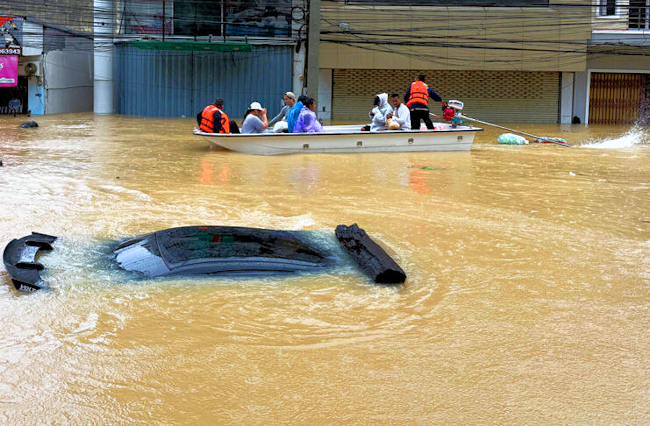

BANGKOK — Widespread flooding continues to batter southern Thailand, where days of torrential rain have inundated entire districts, displaced hundreds of thousands and pushed some areas to crisis levels, according to the Department of Disaster Prevention and Mitigation (DDPM).
As of November 24, floodwaters have hit 10 southern provinces — including Surat Thani, Krabi, Nakhon Si Thammarat, Trang, Phatthalung, Satun, Songkhla, Pattani, Yala and Narathiwat — covering 92 districts and more than 4,100 villages. DDPM said 1.9 million people in roughly 720,000 households have been affected, and water levels in several areas continue to rise.
Rising floodwaters continue to swell across Hat Yai District in Songkhla, with levels expected to peak on the morning of Nov. 25, 2025.
Flooding has also persisted in parts of the northern and central regions, where overflowing rivers have affected 11 provinces. Authorities said water levels there are generally receding, but more than 480,000 people have been impacted.
The Smart Water Operation Center (SWOC) of the Royal Irrigation Department disclosed that the cause of the severe floods in the South is due to the influence of the monsoon trough and low-pressure cell covering the South and lower South since November 19, 2025, until the present.
For Songkhla province, heavy rain covered all areas, especially in Hat Yai district, where the highest rainfall was measured on November 21, at 335 mm., which is the heaviest rainfall in 300 years.
Rising floodwaters continue to swell across Hat Yai District in Songkhla, with levels expected to peak on the morning of Nov. 25, 2025.
Meanwhile, floodwaters continued climbing Sunday night, November 23, as more runoff from the U-Taphao Canal pushed toward the city and additional rain fell across the basin.
DDPM said water levels could peak at 1.25 to 1.45 meters on November 25, with the highest levels expected around 6 a.m. Officials have issued the highest warning and prepared evacuation plans for at-risk communities.
Geography, Weather and Poor Preparedness
Environmental expert Sonthi Kotchawat of the Thai Environmental Scholars Association said the South is experiencing one of its most severe natural disasters in years. All 16 districts of Songkhla Province are flooded, affecting about 150,000 households, and Hat Yai is facing its worst flooding since 2000. Economic losses have already surpassed 500 million baht ($15.4 million), he said.
Sonthi pointed to three key factors:
- Geography
Hat Yai sits on low-lying terrain that slopes toward Songkhla Lake, making it naturally prone to flooding, especially when water levels in the lake rise. The U-Taphao Canal — a 116-kilometer waterway that runs from Sadao District through central Hat Yai — funnels water from multiple tributaries toward the lake. The R.1 Canal, built after the 2000 flood as a royal project, helps divert part of this flow to speed drainage.
Runoff from the Bantad Mountain Range surges into canals and spills into homes in Phatthalung Province on Nov. 24, 2025.
But water from several directions — including runoff from Khao Kho Hong and streams descending from the Nakhon Si Thammarat mountain range — all converge into the U-Taphao Canal before passing through Hat Yai.
- Extreme Weather
A high-pressure system from China combined with a low-pressure monsoon trough and La Niña conditions to produce days of intense rainfall. From November 19–22, accumulated rainfall reached 595 millimeters, surpassing historic peaks recorded in 2000 and 2010. Khao Kho Hong alone saw 365 millimeters of rain on November 22.
That runoff surged into waterways feeding the U-Taphao Canal, overwhelming drainage systems and spilling into Hat Yai’s urban core.
- Inadequate Water Management and Emergency Response
Sonthi said Thailand’s water management has been “far below standard” this year, pointing to widespread flooding across all regions despite early warnings of a volatile La Niña season.
Although disaster alerts were issued one to two days in advance, response efforts have lagged, he said, with many southern residents still stranded without supplies as rescue teams struggle to reach them.
Floodwaters inundate Hat Yai Hospital in Songkhla Province on Nov. 24, 2025.
Unusual Rainfall Pattern.
Asst. Prof. Dr. Somporn Chuayaree of Prince of Songkla University, an expert on southern weather and natural disasters, told BBC Thai that Hat Yai’s flooding this year is different from past events.
He said that after the 2000 flood, the R.1 diversion canal effectively reduced flooding from upstream areas like Sadao and Khlong Hoi Khong. But this year, the heaviest rainfall struck Khao Kho Hong — a mountain range east of the city that does not drain into the diversion canal. Instead, the water rushed directly into Hat Yai’s urban zones along steep slopes.
Combined with torrential rain that also fell directly on the city, the result was the severe, city-centered flooding now unfolding.
Source: Khaosod English